
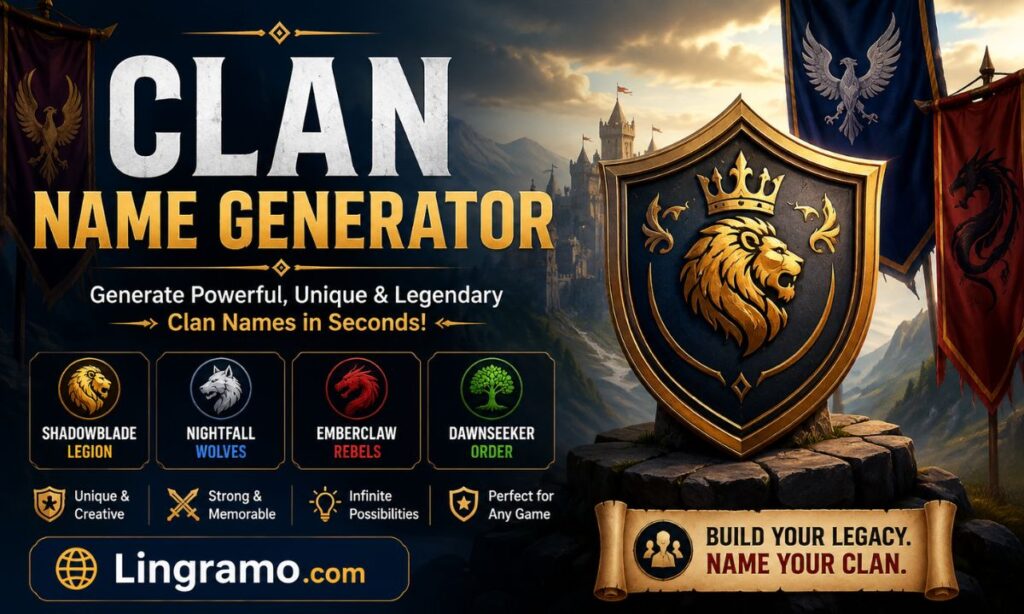
Picking a name for your gaming crew feels small right up until the moment it isn’t. It’s the tag that shows up in the kill feed before anyone knows how you play, the header on your Discord server, the thing printed on a jersey if your squad ever goes pro. A good clan name generator takes the pressure off that decision by giving you dozens of options built around real naming patterns instead of a blank text box and a deadline.
In lingramo this guide walks through what actually makes a clan name land, how naming conventions shift across game genres, and how to turn a generated shortlist into an identity your whole crew is proud to wear.
Also read FS Mean in Text: What It Means in Slang
What Makes a Clan Name Actually Work
Not every name that sounds cool in your head survives contact with a lobby full of strangers. The names that stick share a few traits, and they’re worth checking your shortlist against before you commit.
- It’s easy to say out loud. If your teammates stumble over it in voice chat, it’s already a liability. Names built from short, punchy syllables travel better than anything with three or four awkward consonant clusters.
- It abbreviates cleanly. Most competitive titles cap clan tags at three to five characters, so a name like “Phantom Reapers” needs to shrink to something like [PHR] without losing its identity. Test the abbreviation before you fall in love with the full name.
- It reflects your crew’s personality. A squad that plays loose and chaotic probably shouldn’t call itself something somber and militaristic — the mismatch reads as try-hard rather than intimidating.
- It’s actually available. A name is only useful if you can claim it. Check the handle across the platforms your clan actually lives on — the game client itself, Discord, and whatever social account you use to post clips — before you print it on anything.
- It ages well. Trend-chasing names (anything built around a meme or a patch-specific mechanic) tend to feel dated within a season. Names rooted in a mood or an image — shadow, storm, iron, ash — hold up much longer.
Clan Name Work
A generator speeds up the brainstorming stage, but this checklist is what separates a name you’ll still be using in a year from one you’ll be quietly retiring after your next roster change.
There’s also a psychological side to this that’s easy to underrate. A clan name functions the same way a brand name does for a small business — it sets expectations before anyone has seen you actually play.
A name built around precision and control (Silent Vanguard, Quiet Storm) primes opponents to expect a disciplined, tactical squad, while something loud and aggressive (Warpath, Blood Reapers) sets up an entirely different first impression.
Neither approach is wrong, but the mismatch between a name’s tone and your clan’s actual playstyle is one of the fastest ways to undercut your own reputation before a single match is played. Run a quick gut-check with your teammates: does this name describe how we actually play, or just how we wish we played?
Naming Patterns by Game Genre
Clan naming isn’t one-size-fits-all. The conventions that work for a Warzone squad look nothing like what fits a guild in a fantasy MMO, and knowing the pattern for your genre makes the generator’s output far more useful.
| Genre | Common Pattern | Example Style | Why It Works |
| FPS / Battle Royale (Warzone, Fortnite, Apex) | Short, aggressive, tag-friendly | ShadowStrike, Iron Wolves | Fits inside a 3–5 character clan tag and reads as intimidating in a kill feed |
| MMO / Guild-based (WoW-style titles) | Lore-flavored, place or lineage-based | Ashvale Dominion, Stormcrown | Blends into the game’s fictional world instead of standing out awkwardly |
| MOBA / Team-based esports | Brand-first, memorable as a standalone name | Cloud9-style single word or compound | Needs to work on jerseys, broadcasts, and merchandise, not just in-game |
| Tabletop / Roleplay clans | Cultural or ancestral flavor | Ash Wolves, Bad Axe Brotherhood | Supports a backstory, a sigil, and a motto the group can build around |
| Casual / Friend-group squads | Inside-joke or personality-driven | LaughingReapers, DangerZoneDelinquents | Prioritizes fun and shared history over intimidation |
The through-line across every genre is the same: the naming convention should match where the name will actually be seen. A name built for a lore-heavy MMO guild will feel out of place slapped onto a Call of Duty tag, and vice versa. When you run a clan name generator, filter results through your genre’s pattern first — theme second, individual words last.
How It Helps
It also helps to think about where the clan name has to live outside the game itself. A guild name in an MMO mostly needs to work inside a chat window and a roster list, so longer, more atmospheric names are fine.
A competitive FPS or battle royale clan name has to survive being shouted across voice chat mid-firefight, so brevity matters more than flavor. A MOBA or franchised esports team name has the hardest job of all — it needs to work as a spoken brand on a broadcast, print cleanly on a jersey, and still sound sharp years later after the roster has completely turned over. Matching the pattern to the platform up front saves you from generating dozens of names that sound great on paper but fall apart the moment they’re actually used.
Also read 335+ Best Donkey Names (Unique, Funny, Male & Female)
Avoiding the Cliché Trap
There’s a specific graveyard of clan names that every veteran player has seen a hundred times: anything ending in “Squad123,” anything with “Pro” or “Elite” bolted onto the front, anything that tries too hard to sound dangerous and ends up sounding generic instead. These names aren’t bad because the words are wrong — they’re bad because thousands of other clans reached for the exact same words.
A few patterns worth steering around:
- Numbers as filler. Adding digits to a name usually signals that the word you actually wanted was already taken. It reads as an afterthought rather than a choice.
- Overused power words with no context. “Legion,” “Titan,” and “Shadow” aren’t bad on their own, but stacked without any twist, they blur into a wall of names that all sound identical.
- Copy-pasting from a top esports org. Borrowing the naming formula from Cloud9 or FaZe Clan might feel like a shortcut to credibility, but it usually just invites comparisons your clan hasn’t earned yet.
- Trying to be intimidating and funny at once, badly. Combining tones can work — “LaughingReapers” pulls it off — but it takes a genuinely clever pairing, not just two unrelated words jammed together.
Avoiding Trap
The fix isn’t to avoid strong words entirely; it’s to combine them in a way that’s specific to your clan. Pairing a material or element with a place, creature, or trait — iron plus vale, ash plus wolves, storm plus crown — produces something that still sounds powerful but doesn’t blend into the crowd of names using the exact same three words everyone else picked.
A useful test before finalizing anything: search the exact name and see how many clans, guilds, or channels already use it. If the first page of results is full of near-identical matches, that’s not proof you’ve found a strong formula — it’s proof you’ve landed on the same shortcut a thousand other clans already took. The names that actually stand out in a lobby or a bracket are almost always the ones with one small, specific twist that a generic search wouldn’t surface.
Building Identity Around Your Name
The name is the starting point, not the finish line. Clans that feel established, rather than thrown together the night before a tournament, usually build a small identity kit around the name itself:
- A short motto. One sentence that captures the clan’s attitude does more for identity than a long paragraph of lore ever will.
- A simple color palette. Two colors, consistently used across logos, banners, and jerseys, make a clan instantly recognizable even before anyone reads the name.
- A visual mark or sigil. It doesn’t need to be elaborate — a clean icon that pairs with the name (a wolf for the Ash Wolves, a crown for Stormcrown) is enough to anchor the brand.
- A consistent tag format. Decide early whether your bracketed tag goes before or after player names, and keep it identical across every platform your clan uses.
This is also where a resource like Lingramo becomes genuinely useful — beyond just generating the name itself, it’s worth having a reference point for the language, tone, and naming conventions behind different words before you commit one to your permanent brand.
A quick gut-check on a word’s connotation or origin can save a clan from picking a name that means something unintended in another context, which matters more than people expect once a clan starts growing beyond its original friend group.
Using the Generator
Getting useful results out of a clan name generator comes down to giving it the right inputs rather than mashing the button until something sounds decent.
- Start with a keyword, not a full concept. A single word — “ash,” “storm,” “iron” — gives the generator room to combine it in ways you wouldn’t think of yourself. A full phrase locks the output down too early.
- Pick the genre or style filter first. If the tool offers style options (fantasy, tryhard, military, casual), set that before generating. It narrows results toward names that actually fit your platform.
- Generate in batches, not one at a time. Look at 20–30 names in one pass rather than judging each result individually — patterns you like will start to repeat, which tells you what direction to lean into.
- Save your shortlist as you go. Star or copy anything with potential, even if it’s not quite right, since combining two saved names is often more effective than starting over.
- Test the abbreviation and the pronunciation before finalizing. Say it out loud, and try writing it as a bracketed tag, before you take it to the rest of the clan for a vote.
Also read 850+ Femboy Names That are Funny, Unique, Cool & More ideas
Treat Generators
Treat the generator as a brainstorming partner rather than a vending machine — the best result usually comes from combining a generated name with a small tweak of your own, not from taking the very first suggestion.
Here’s a quick example of how that plays out in practice: a squad set on a “storm” theme for a battle royale roster might run the keyword through a clan name generator and get back options like Stormcrown, Storm Wolves, and Silent Storm.
None of them is quite right on its own, but noticing that “Silent” pairs well with the storm theme leads to a hybrid — Silent Squall — that’s shorter, abbreviates cleanly to [SSQ], and still carries the original mood. That kind of remixing, rather than picking straight from the list, is usually what separates a clan name that feels custom from one that feels like it was pulled off a shelf
Conclusion
A clan name is a small decision that carries more weight than it first appears — it’s the first impression your group makes in every lobby, bracket, and server invite. The fastest path to a name that actually holds up is combining a clan name generator’s raw output with the genre-specific patterns, cliché checks, and identity-building steps covered above.
Run a few keyword batches, filter for what fits your platform, test the abbreviation out loud, and bring your shortlist to the crew before locking anything in. Get that process right once, and it’s a decision your clan won’t need to revisit every few months.
Common Questions
Do I need to check if a clan name is already taken?
Yes — search the name inside your main game, on Discord, and on any social platform your clan is active on before you commit to it publicly.
How short should a clan tag be?
Most competitive games cap tags at three to five characters, so pick a full name that abbreviates cleanly to that length.
Can I use the same clan name across multiple games?
You can, but genre-neutral names (built around a mood or image rather than a specific mechanic) tend to transfer better than names tied to one game’s lore.
Is it okay to trademark or brand a clan name later?
It’s possible, but check for existing organizations using something similar first, since larger esports orgs often have specific naming and trademark protections in place.
What makes a clan name sound intimidating without being generic?
Combine a distinct word (a material, place, or creature) with a second element rather than relying on stock power words like “Legion” or “Elite” on their own.
Also read 560+ Octopus Names That Are Clever, Cute, Creative & More