
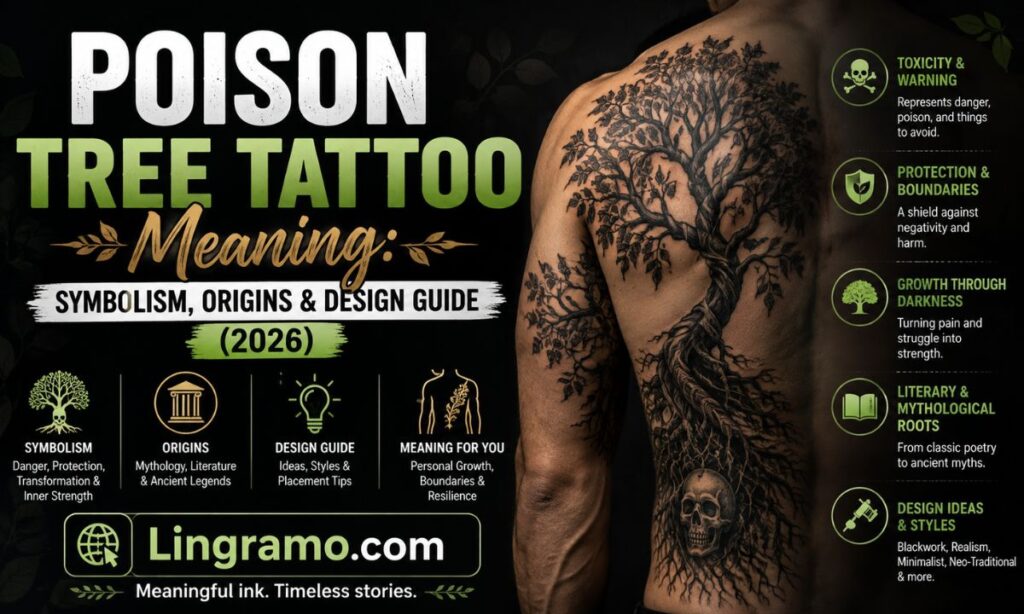
A Poison Tree Tattoo Meaning doesn’t grow overnight, and neither does the anger it stands for. That’s the quiet power behind the poison tree tattoo — a design that looks unsettling at first glance but usually tells a very human story about the feelings people carry and never quite say out loud.
If you’ve been staring at photos of twisted trunks, bare branches, and single glowing pieces of fruit and wondering what you’d actually be putting on your skin, you’re in the right place.
This guide walks through everything worth knowing before you sit in the chair: where the symbol comes from. what the poison tree tattoo meaning really covers, who tends to choose it, and how small design choices — color, placement, style — shift what the piece says about you.
The Lingramo team put this together the way we approach every symbol guide: rooted in the source material, checked against how people actually use the design today, and written so you leave with a clear answer instead of more questions.
Also read IHY Meaning in Text: Discover Real Meaning Behind IHY in Chats
What Is a Poison Tree Tattoo?
A poison tree tattoo is a piece of body art built around a dark, often gothic tree — twisted trunk, bare or thorny branches, and usually one striking piece of fruit hanging from a low limb. It isn’t meant to look like a tree you’d find in a park.
The bark is cracked on purpose. The branches reach out at odd angles instead of growing naturally upward. The fruit, when it’s there, tends to be oversized, glossy, or an unnatural color, as if it’s giving off a quiet warning.
Unlike a tree of life tattoo, which usually celebrates growth, family, or resilience, the poison tree leans into discomfort. It’s supposed to feel a little wrong to look at, because the emotion behind it — buried resentment — isn’t a comfortable feeling either. The design works as a kind of visual metaphor: something small and hidden (a seed, a silence, a swallowed reaction) eventually grows into something with real weight and consequence.
Most versions include a few recognizable features:
- A trunk that looks strained, cracked, or gnarled rather than smooth
- Bare, thorny, or claw-like branches instead of full foliage
- A single striking fruit, often shown as the visual “payoff” of the piece
- Roots drawn digging deep into the ground, suggesting something long-established
- Heavy shading or limited color, which keeps the mood dark even in larger pieces
The Origins: William Blake’s “A Poison Tree” (1794)
The design traces directly back to literature rather than folklore or mythology. English poet and artist William Blake wrote “A Poison Tree Tattoo Meaning” in 1794 as part of his collection Songs of Experience, a set of poems built around loss of innocence and the darker side of human nature.
The poem’s plot is short but pointed. The speaker is angry with a friend, says so, and the anger passes. The speaker is then angry with an enemy, stays silent about it instead, and that silence becomes the seed of something worse.
Blake describes watering the anger with fears and tears and warming it with smiles — deceit dressed up as calm. Over time it grows into a tree, and the tree produces a single bright apple. The enemy, drawn in by the fruit, eats it and dies.
Blake wasn’t writing a gardening metaphor for fun. He was making a psychological point that still holds up more than two centuries later: emotion you refuse to express doesn’t disappear, it gets cultivated. What you don’t say out loud, you end up feeding in private, and it tends to come back changed — and usually worse than if you’d just said it in the first place.
That’s the exact reason the image translates so well to skin. A tattoo is permanent, visible, and personal, which makes it a natural home for a lesson about what happens when feelings are left to grow unchecked rather than released.
Poison Tree Tattoo Meaning: Core Symbolism
At its center, the poison tree tattoo meaning comes down to one idea: suppressed emotion doesn’t stay small. Anger, resentment, grief, or betrayal that never gets voiced tends to compound quietly until it becomes something the person can no longer ignore.
Beyond that central theme, the symbol carries a few layered meanings depending on how the wearer interprets it:
- Suppressed anger — the most literal reading, taken straight from Blake’s poem, representing feelings that were bottled up instead of expressed.
- Betrayal and broken trust — many wearers connect the tree to a specific relationship where honesty broke down.
- Consequence and responsibility — the poem doesn’t let the speaker off the hook; the tree grows because of a choice, not by accident. Some people read the tattoo as a personal reminder that silence has effects too.
- Transformation and healing — for a large share of wearers, the tattoo isn’t a celebration of darkness at all. It marks the point where they recognized a pattern and chose to stop repeating it.
- Temptation and forbidden knowledge — the single glowing fruit echoes older symbols, from the Garden of Eden to Greek myths about guarded golden apples, adding a layer of moral tension to the design.
It’s worth noting the tone most wearers actually attach to the piece. Despite the dark visual style, the poison tree tattoo meaning is rarely “I am toxic.” It’s closer to “I understand how toxicity forms,” which is a very different, far more reflective statement.
Who Gets a Poison Tree Tattoo — and Why
There’s no single type of person who chooses this design, but a few patterns show up consistently in why people book the appointment.
A lot of requests come from people who’ve recently left a relationship — romantic, family, or professional — where staying quiet felt like the only safe option for a long time. For them, the tattoo marks the moment they stopped absorbing someone else’s behavior and started naming it.
Others get the design as a straightforward literary tribute, drawn to Blake’s poem on its own merit rather than any specific personal event. English majors, poetry readers, and dark-academia fans fall into this group often.
There’s also a smaller but consistent group who use the tattoo as a personal warning system — a visible reminder not to let their own resentment build in silence again. And some wearers are simply drawn to the aesthetic first: the gothic linework, the moody shading, the single dramatic piece of fruit. The literary weight becomes a bonus rather than the main draw.
Age and background vary widely across these groups, but the common thread is emotional honesty. Almost nobody gets this tattoo casually, which is part of why it tends to age well emotionally — it’s less a trend piece and more a personal milestone marked in ink.
Also read 600+ Best Goat Names Ideas: Unique & Funny Names
Popular Design Variations
Tattoo artists have taken Blake’s central image in a lot of directions since the poem first became tattoo shorthand. Below are the variations that show up most often in studio portfolios and client requests.
Black and Grey Gothic Style
The most traditional take on the design: thick, gnarled roots, heavy shadow work, and branches bent into sharp, aggressive shapes. This version leans fully into the poem’s darker undertones and suits larger canvases like the forearm, thigh, or back, where the shading has room to breathe.
Blake-Inspired Illustration
Designed to look like it was pulled straight from a 1790s engraving. This variation often includes fine crosshatching and, in some cases, a fragment of the poem’s actual text curling around the trunk or branches — a direct nod to the source material rather than just the imagery.
Half-Dead, Half-Living Tree
One side of the tree is cracked, bare, and lifeless; the other is green, leafy, and thriving. It’s one of the more requested variations right now because it reframes the symbol as hopeful rather than purely dark — a visual record of growth after emotional damage instead of just the damage itself.
Serpent and Fruit Motif
Adding a snake coiled around the trunk or a branch pulls in Garden of Eden imagery, layering temptation and betrayal on top of Blake’s original meaning. This version tends to appeal to wearers who want the piece to feel mythic and biblical rather than strictly literary.
Heartfruit Design
A variation where the tree’s signature fruit is shaped like a heart instead of an apple, shifting the focus toward romantic betrayal specifically rather than anger in general. It’s a popular pick for anyone whose “poison” traces back to one particular relationship.
Minimalist Line Art
A stripped-down, single-line tree with no shading and minimal detail. Popular for smaller placements like the wrist, ankle, or ribs, this style delivers the meaning without the heavier, more visually intense look of the gothic versions.
Watercolor Style
Soft blues, purples, or greens bleeding out behind a black outline. This approach softens the poem’s grim ending visually while keeping the core symbolism intact, and it tends to appeal to wearers who want an emotional piece that still feels soft rather than harsh to look at.
Color Meanings in Poison Tree Tattoos
Color choice changes the tone of a poison tree tattoo meaning more than almost any other design decision. The table below breaks down how the most common palettes tend to be read.
| Color | Common Meaning |
| All black | Mystery, restraint, and internal struggle; the most requested palette overall |
| Deep red (fruit or accents) | Anger, danger, and the pull of temptation |
| Green | Toxic growth, but also natural life and the possibility of renewal |
| Purple or dark blue washes | A dreamlike, haunting quality; often paired with the half-dead, half-living version |
| Muted grey | Emotional balance, quiet reflection, and a softer read on the same story |
| Mixed / multi-color | Layered, complex meaning that reflects more than one emotion at once |
Black remains the default for a reason — it keeps the design feeling serious and restrained, which fits the tone of Blake’s poem. Wearers who want the piece to feel more personal or less severe often introduce a single accent color rather than going fully colored.
Best Placement Options for a Poison Tree Tattoo
Placement affects both how visible the piece is day to day and how the design itself has to be built, since more detailed trees need more surface area to read clearly.
- Forearm — one of the most popular spots for this design, offering enough space for roots, trunk, and fruit while staying easy to show or cover depending on the setting.
- Back or shoulder blade — ideal for larger, more detailed pieces, since the flatter surface holds fine linework and shading well over time.
- Chest — a common choice for wearers who want the symbolism placed literally near the heart, keeping the meaning private and personal.
- Ribs or behind the ear — smaller, more discreet spots favored by people who want the meaning without making a visible public statement.
- Thigh — another strong option for bigger, more detailed gothic versions that need room for heavy shading.
As a general rule, flatter areas like the outer forearm or upper back hold fine root and branch linework better over the long term than spots near joints, which shift more with movement and can subtly distort detailed work after several years.
Also read 740+ Best Lamar Jackson Fantasy Football Team Names 2026
Psychological Dimension: Why This Symbol Resonates So Deeply
The reason the poison tree tattoo keeps showing up in tattoo studios more than two hundred years after Blake wrote the poem isn’t really about the visual style — it’s about how accurately it describes something most people have lived through.
Almost everyone has swallowed a reaction they should have voiced, and almost everyone has felt that unspoken feeling resurface later, usually bigger and messier than it started out.
Psychologically, the design captures the mechanics of suppression better than most symbols manage. Anger that isn’t expressed doesn’t vanish; it gets redirected, stored, and often reshaped into something less honest than the original feeling — resentment, passive aggression, or a grudge that outlives the situation that caused it. Wearing that idea permanently functions almost like a self-directed accountability check. It’s a reminder to name what’s happening internally before it has the chance to take root.
There’s also a duality built into the symbol that a lot of people find meaningful: the tree is simultaneously the wound and the warning. It represents both the damage caused by staying silent and the awareness that comes from finally recognizing the pattern.
That combination — pain and insight in the same image — is part of why so many wearers describe the tattoo as reflective rather than negative, closer to “I understand how poison forms” than “I am poison.”
Final Thoughts
A poison tree tattoo isn’t just a striking piece of dark body art — it’s a two-hundred-year-old psychological observation turned into something permanent and personal. Whether you’re drawn to it for Blake’s poem, for a specific relationship you’ve moved past, or simply for the aesthetic, the meaning holds up because the feeling behind it is universal: what you don’t say tends to grow anyway.
If you’re still deciding on a design, spend time comparing styles and placements before booking — a half-dead, half-living tree tells a very different story than a stark blackwork gothic version, even though both trace back to the same poem. For more symbol breakdowns, slang explainers, and meaning guides like this one, the Lingramo library is a good next stop.
Frequently Asked Questions
What does a poison tree tattoo mean?
It typically symbolizes suppressed anger and hidden resentment, based on William Blake’s 1794 poem “A Poison Tree,” where emotions left unspoken grow into something destructive.
Is a poison tree tattoo a bad or negative symbol?
Not usually. Most wearers use it to represent healing, self-awareness, and emotional honesty rather than darkness for its own sake.
Where did the poison tree tattoo design come from?
It comes from William Blake’s poem “A Poison Tree,” published in his 1794 collection Songs of Experience.
What’s the difference between a poison tree tattoo and a tree of life tattoo?
A tree of life tattoo generally celebrates growth, family, and resilience, while a poison tree tattoo focuses on suppressed emotion and its consequences — visually similar, but almost opposite in meaning.
What’s the best placement for a poison tree tattoo?
The forearm, back, and chest are the most popular choices, since each offers enough space for detailed roots, branches, and fruit while suiting different levels of visibility.
Also read Funny Cow Names That Will Make You Laugh Instantly