
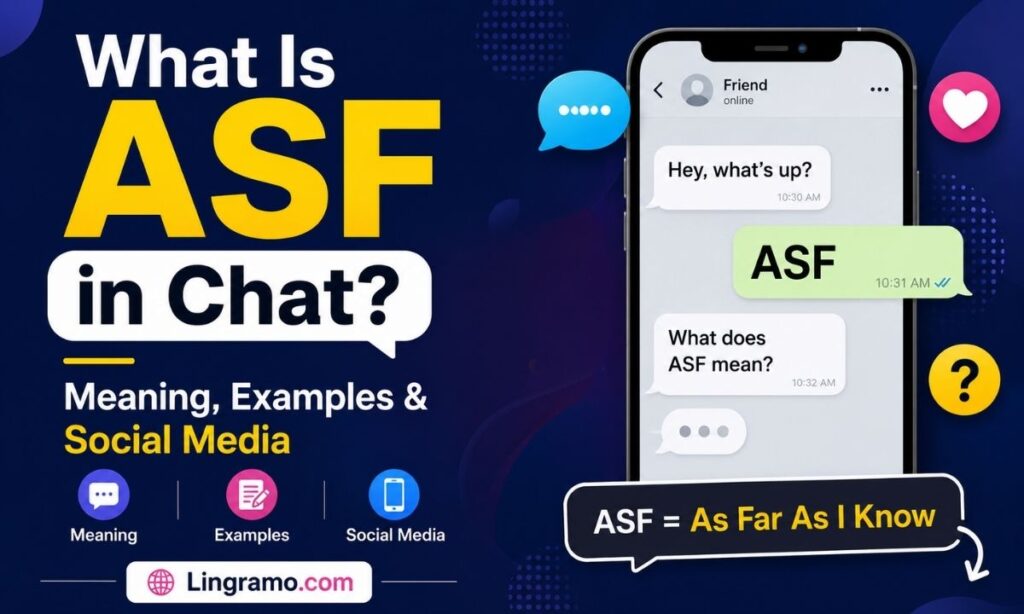
Scroll through any TikTok comment section or WhatsApp group chat for five minutes, and the letters ASF will probably show up right after someone’s mood, opinion, or reaction. What is ASF in chat, exactly? It’s one of those short, punchy slang terms that context alone doesn’t always explain, especially if you’re new to how Gen Z and social media users talk online.
This guide breaks the term down in plain English — where it comes from, what it really means, how it shifts across Instagram, TikTok, and text messages, and when it’s better left unused.
By the end, reading or replying to an ASF message won’t feel confusing anymore, and that’s exactly the kind of clarity Lingramo aims to give readers trying to keep up with fast-moving internet language.
Also read 304 Meaning: What It Means in Text, Social Media, and the Internet
What Is ASF in Chat? – Quick Meaning
Simple Meaning
ASF in chat is a slang abbreviation that stands for “as f*ck.” In plain terms, it works as an intensifier — a quick way of saying “very,” “extremely,” or “really” without typing the longer word out. When someone writes “tired ASF,” they mean they are extremely tired, not just a little sleepy. The letters carry the emotional weight of the sentence, which is exactly why the term spread so fast in casual texting and social media.
Examples
Example 1: Everyday Texting
“This traffic is bad ASF today.” Here, ASF simply pushes “bad” into “unbelievably bad.”
Example 2: Reacting to Content
“That trailer looked good ASF.” The word amplifies excitement about something someone just watched.
Example 3: Describing a Feeling
“I’m hungry ASF right now.” A short, casual way of saying the hunger feels intense.
What It Expresses
At its core, ASF communicates emotional emphasis. People reach for it when they want a message to sound expressive, relatable, funny, or dramatic without writing a full paragraph. It’s less about the literal words and more about signaling “I feel this strongly,” which is why tone and relationship with the other person shape how it lands.
Origin & Background
Social Media Influence
ASF in chat didn’t start in a dictionary — it grew out of texting culture and spread through platforms where short, emotional communication matters more than formal grammar. Comment sections, captions, and group chats rewarded quick, punchy phrasing, and ASF fit that mold perfectly.
How the Meaning Evolved
Early on, the abbreviation was mostly used to intensify obvious feelings like tiredness or hunger. Over time, its use broadened into humor, sarcasm, flirting, and even mild complaints, following the same evolution as its close cousin AF. The core meaning barely changed; what changed is how many situations people now drop it into.
Language moves faster online than it ever did in print, and abbreviations like ASF are a good example of that shift. A phrase that might have taken years to spread through spoken slang can now travel across TikTok, Instagram, and group chats in a matter of weeks, picked up by one viral comment section and repeated by thousands of users almost overnight. That speed is part of why new readers sometimes feel like they’ve missed a memo — by the time a term becomes noticeable enough to ask about, it’s often already been in circulation for a while among heavier social media users.
Real-Life Conversations
Seeing ASF in chat in actual chat threads makes the pattern click faster than any definition could.
WhatsApp Conversation
Friend: “How was the exam?” You: “Brutal ASF, I need a nap.”
Instagram DM
Friend: “Did you see her new post?” You: “Yes, the outfit is cute ASF 😍”
TikTok Comments
Comment: “This song is catchy ASF, I’ve replayed it ten times.”
Text Message
Text: “Work today was slow ASF, nothing happened.”
Across every platform, the pattern stays the same: ASF sits right after a feeling or description and cranks up the intensity.
Emotional & Psychological Meaning
Why People Use It
Text strips away tone of voice and facial expression, so people look for shortcuts to restore emotional intensity. ASF fills that gap in three letters, letting someone express frustration, excitement, or exhaustion without over-explaining.
What It Reveals About Modern Communication
The popularity of terms like ASF says something about how digital conversation has changed. Speed and emotional impact often matter more than formal grammar, and short slang keeps messages feeling immediate, casual, and relatable rather than stiff.
Personal-Style Scenario
Picture a college student texting a friend right after finals: “Done ASF, never doing that again.” That single line communicates exhaustion, relief, and drama all at once — something a longer, formal sentence would take three times as many words to say.
This is also why slang like ASF in chat tends to survive longer than people expect. It’s not just filler; it does real communicative work by compressing emotion into a form that’s quick to type and quick to read. Someone scrolling through dozens of messages a day doesn’t have time to parse long, carefully worded sentences from every friend, so a short intensifier that instantly signals “this matters to me” ends up being genuinely useful, not just trendy.
Also read CLFS Meaning in Text Explained Clearly for Everyone
Usage in Different Contexts
Social Media
On Instagram, TikTok, and Twitter/X, ASF shows up constantly in captions, comments, and replies, usually attached to reactions about mood, appearance, or content quality.
Friends & Relationships
Among close friends, ASF feels natural and even affectionate — it’s a marker of casual, comfortable communication rather than something formal or distant.
Work / Professional Settings
In work emails, client messages, or anything formal, ASF should be avoided entirely. Its casual, mildly vulgar origin makes it a poor fit for professional tone.
Casual vs Serious Tone
The same word can read as playful in a joke between friends or oddly harsh in a serious conversation. Reading the surrounding message matters just as much as the abbreviation itself.
When NOT to Use It
Avoid Using ASF:
- In job applications, resumes, or cover letters
- In emails to colleagues, clients, or teachers
- When messaging someone you don’t know well
- In any formal or official written communication
Cultural Sensitivity
Because ASF is rooted in a swear word, some cultures and communities may find it more inappropriate than others. It’s worth reading the room before using it with someone from a more formal or conservative background.
Potential Misunderstanding
Not everyone recognizes internet slang the same way. Someone unfamiliar with ASF might read it as confusing, rude, or even mistake it for an unrelated term entirely, so context and audience always matter.
Common Misunderstandings
People Think It Has Multiple Official Meanings
Outside of chat and social media,ASF in chat is also a recognized abbreviation in other fields — for example, it refers to African Swine Fever in agricultural and veterinary contexts. That version has nothing to do with texting slang, but the overlap sometimes confuses people searching the term online.
Tone Confusion
Because ASF has no built-in punctuation or emoji, readers sometimes struggle to tell if it’s meant seriously, sarcastically, or jokingly. Adding an emoji usually clears that up quickly.
Literal vs Figurative Meaning
ASF is almost never meant literally. “Starving ASF” doesn’t mean someone hasn’t eaten in days — it just means they’re very hungry right now. Reading it figuratively avoids most confusion.
Comparison Table
| Term | Meaning | Common Platforms | Tone |
| ASF | As f*ck / extremely | TikTok, Instagram, WhatsApp, SMS | Casual, expressive |
| AF | As f*ck / extremely | Twitter/X, texting | Casual, slightly more mainstream |
| Very | Standard intensifier | Any setting | Neutral, formal-safe |
| Extremely | Standard intensifier | Any setting | Formal |
| Super | Casual intensifier | Everyday speech, texting | Friendly, informal |
Key Insight
ASF and AF mean essentially the same thing and are often used interchangeably, but ASF tends to feel slightly more casual and playful, while “very” or “extremely” remain the safer choice for professional writing.
Variations / Types
1. Funny ASF
Used for anything that made someone laugh unexpectedly hard.
2. Tired ASF
The most common everyday use, describing exhaustion after work, school, or a long day.
3. Busy ASF
Signals a packed schedule or a hectic moment, often used to explain a delayed reply.
4. Cute ASF
Common on Instagram captions and comments describing outfits, pets, or photos.
5. Loud ASF
Describes noise, music, or an overly dramatic situation.
6. Cold ASF
Almost always about weather, though occasionally used to describe someone’s blunt attitude.
7. Mad ASF
Expresses strong frustration or anger in a casual, non-formal way.
8. Happy ASF
Used to express genuine excitement or good news.
9. Broke ASF
A common, half-joking way to describe having little money left.
10. Weird ASF
Describes something unusual, confusing, or unexpected.
Also read What Does SPWM Meaning in Text Really Stand For Today
How to Respond When Someone Uses It
Casual Replies
“Same honestly” or “lol relatable” keeps the tone light and matching.
Funny Replies
Responding with an exaggerated joke back usually keeps the exchange playful.
Mature Replies
A simple “that sounds rough, hope it gets better” works fine if the message reads as genuinely stressed rather than jokey.
Respectful Replies
If the tone or context feels off, it’s fine to respond normally without mirroring the slang at all.
Regional & Cultural Usage
Western Culture
ASF in chat is widely recognized and used across the US, UK, Canada, and Australia, especially among teens and young adults.
Asian Culture
In many South and Southeast Asian countries, ASF has spread through English-language social media use, often mixed into local-language sentences the same way English loanwords typically are.
Middle Eastern Culture
Younger, social-media-active users in the region use ASF similarly to Western audiences, though it appears less in formal Arabic-language conversations.
Global Internet Usage
Because platforms like TikTok and Instagram operate worldwide, ASF has spread well beyond any single country, becoming part of a broader shared internet vocabulary. Hashtags, trending sounds, and viral captions all help carry slang like this across borders far faster than older forms of media ever could, which is part of why a term coined in one region can show up in an unrelated country’s group chats within the same year.
Generational Differences
Gen Z
Gen Z uses ASF the most frequently and comfortably, treating it as a normal part of everyday digital conversation rather than something edgy.
Millennials
Millennials recognize and use the term, often alongside its predecessor AF, though usage tends to be slightly less frequent than among younger users.
Older Generations
Many older users either don’t recognize ASF at all or find it unnecessarily casual, which is part of why it’s rarely a good fit for cross-generational or formal communication. A parent or grandparent seeing “tired ASF” in a text might read it as a typo before realizing it’s intentional slang, which is a good reminder to switch to plainer language when messaging across generations.
Is It Safe for Kids?
Because ASF in chat is built from a swear word, it isn’t ideal for young children to use, even though most kids using it aren’t trying to sound vulgar. Parents and educators may want to explain what the abbreviation actually stands for so kids understand why it’s not appropriate in school assignments, messages to teachers, or family group chats.
For older teens, understanding the term is mostly about knowing where the line between casual friend-to-friend texting and formal communication sits.
It also helps to remember that slang censorship rules differ by platform. Some apps automatically filter out fully spelled-out profanity, which is part of why abbreviated forms like ASF became popular in the first place — they carry the same emotional punch while sliding past basic word filters.
Understanding that distinction can make conversations with kids about online language feel less like a lecture and more like an honest explanation of how internet communication actually works.
Conclusion
ASF in chat might look confusing the first time it shows up in a chat, but the idea behind it is simple: it’s a fast, expressive way of saying “very” or “extremely” that fits naturally into texting, Instagram captions, TikTok comments, and everyday conversations with friends.
Knowing when it fits — and when to skip it for a more formal word — makes reading and replying to modern digital conversation a lot easier. Guides like this one from Lingramo exist for exactly that reason: to help readers keep up with the internet’s constantly shifting slang without needing to guess.
Frequently Asked Questions
What does ASF mean in a text message?
ASF means “as f*ck,” used casually to intensify a feeling or description, similar to saying “very” or “extremely.”
Is ASF the same as AF?
Yes, they mean the same thing; ASF just adds one extra letter and feels slightly more casual.
Is it rude to use ASF?
It’s mildly vulgar because of its origin, but most people don’t use it with rude intent — context and audience decide whether it lands as fine or inappropriate.
Can ASF be used in professional messages?
No, it’s best avoided in emails, job applications, or any formal communication.
Does ASF mean something else outside of slang?
Yes, in agricultural contexts ASF refers to African Swine Fever, which is unrelated to the texting slang meaning.
Also read 500+ Cool Snake Names: Cool Unique & Funny For Male & Female