
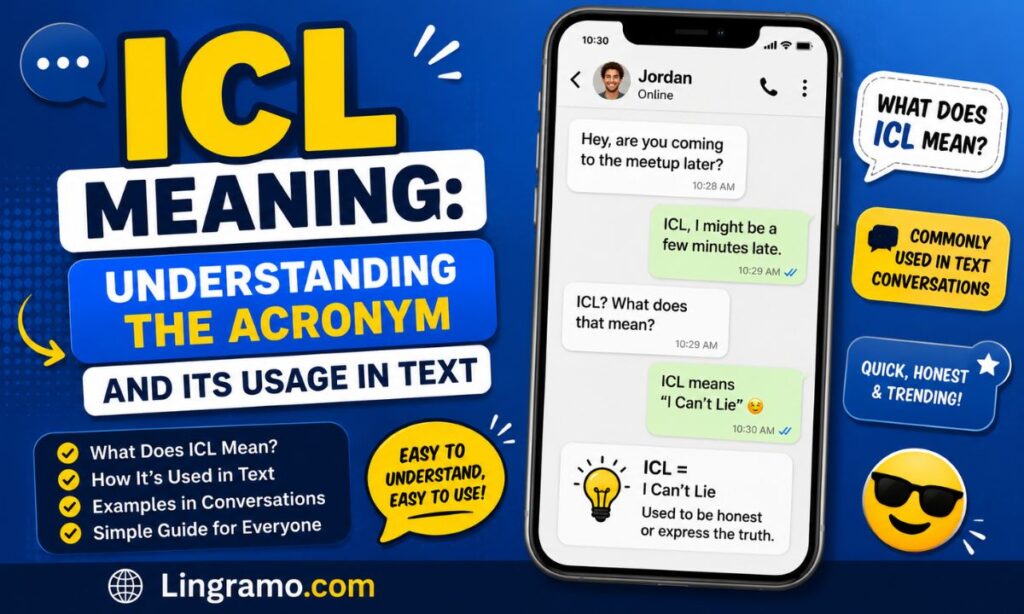
Scrolling through a group chat, a comment section, or a TikTok caption, most people eventually run into three letters that seem to show up everywhere: ICL meaning. At first glance it looks like just another random string of texting shorthand, but it actually carries a specific meaning that’s become a regular part of how people communicate online.
Understanding ICL meaning helps make sense of casual conversations, social media captions, and the honest confessions people love to drop into a chat. This guide, brought to you by Lingramo, breaks down exactly what ICL stands for, how it’s used, and why it has become such a fixture of modern texting culture.
What Does ICL Mean?
In most everyday texting and social media use, ICL stands for “I Can’t Lie.” It’s a short phrase people drop into a message right before sharing something honest, whether that’s a genuine opinion, a small confession, or a reaction they didn’t expect to have. Instead of typing out the full sentence, people shorten it to three letters, which keeps conversations quick and casual.
The acronym shows up constantly across TikTok comments, Snapchat captions, Instagram stories, and regular text messages. Someone might write “icl that new song has been on repeat all week,” which really just means “honestly, that new song has been on repeat all week.” It works almost identically to phrases like “to be honest” or “not gonna lie,” just packaged into a shorter, more casual form that fits the pace of digital conversation.
While “I Can’t Lie” is by far the most common interpretation, ICL isn’t always locked into one single meaning. Depending on the platform, the person typing it, and the tone of the conversation, it can shift slightly — which is exactly why context matters so much when reading it.
1. I Can’t Lie
This is the definition almost everyone lands on first, and for good reason — it’s the version used in the overwhelming majority of everyday texts. When someone types ICL, they’re usually about to say something honest, even if it’s a little unexpected or slightly embarrassing to admit.
Example
“icl I’ve watched that movie like five times this month.”
Here, ICL signals that the person is being upfront about something they might normally downplay. It adds a small dose of sincerity to an otherwise casual statement, almost like a verbal shrug before an honest admission.
This usage tends to pop up before compliments, confessions, or blunt opinions — situations where the speaker wants to make clear they’re not exaggerating or being sarcastic.
2. I Care Less
A smaller but still notable interpretation of ICL is “I Care Less,” used to express indifference rather than honesty. This version shows up less often, but it does appear in certain comment sections and casual replies where someone wants to brush something off.
Example
“icl what people think of my outfit.”
In this context, the person isn’t confessing anything — they’re signaling that a topic simply doesn’t matter much to them. Because this meaning overlaps in spelling with the more common “I Can’t Lie,” it can occasionally cause confusion, which is exactly why reading the surrounding sentence matters more than the acronym alone.
3. Other Interpretations
Outside of casual texting, ICL can carry entirely different meanings depending on the setting. In medical contexts, for instance, ICL refers to an Implantable Collamer Lens, a type of corrective eye surgery — a meaning with zero connection to texting slang. In gaming communities and some niche forums, ICL occasionally stands for other localized phrases specific to that group.
These alternate meanings are far less common in everyday texting, but they’re worth knowing, especially if ICL shows up somewhere outside a typical group chat or social media comment.
The Importance of Context
Context does most of the heavy lifting when it comes to figuring out what ICL actually means in a given message. The same three letters can shift meaning depending on who’s typing them, where the conversation is happening, and what comes right after.
A few things worth paying attention to:
- The platform — Snapchat and texting conversations lean almost entirely toward “I Can’t Lie,” while broader social comment sections sometimes lean toward “I Care Less.”
- The tone of the message — an enthusiastic follow-up usually signals honesty, while a dismissive one-liner leans toward indifference.
- The relationship between sender and receiver — close friends often use ICL more casually and frequently than acquaintances.
Reading the full sentence, not just the acronym, almost always clears up any ambiguity within seconds.
Alternatives to “I Can’t Lie”
Plenty of other phrases carry a similar meaning to ICL, and they’re often used interchangeably depending on personal texting habits. Some common alternatives include:
- “To be honest”
- “Not gonna lie”
- “Honestly speaking”
- “I’ll be real”
- “If I’m being truthful”
While these all express roughly the same sentiment, ICL has carved out its own space simply because it’s faster to type and feels a little more casual than its full-sentence counterparts.
Choosing the Right Expression
Picking between ICL and similar phrases often comes down to tone and audience. ICL tends to feel more casual and youth-oriented, making it a natural fit for close friend groups, comment sections, and fast-paced conversations.
Phrases like “to be honest” or “honestly speaking” read as slightly more formal, which makes them a better fit for messages to coworkers, older relatives, or anyone outside a casual social circle.
There’s no strict rule here — it’s really about matching the acronym’s energy to the setting. Using ICL in a professional email would likely feel out of place, while dropping “to be honest” into a group chat with friends might come across as a bit stiff.
How ICL Became Popular in Teen Texting Culture
Like many internet acronyms, ICL didn’t appear overnight. It grew out of a broader trend of shortening common phrases for faster typing, a habit that’s been part of texting culture since the earliest days of SMS. As mobile messaging apps and social platforms evolved, so did the appetite for quick, casual shorthand that could keep up with rapid-fire conversations.
TikTok and Snapchat played a major role in pushing ICL into mainstream teen vocabulary. Short-form video captions and quick-reply comment sections rewarded brevity, and acronyms like ICL fit perfectly into that space. Once it started appearing consistently in captions and comments, it spread quickly through group chats and everyday texting among teens and young adults.
ICL vs TBH vs NGL: What’s the Difference?
ICL often gets grouped with other honesty-signaling acronyms like TBH and NGL, and while they’re similar, small differences in tone set them apart.
| Acronym | Full Form | Typical Tone | Common Use |
| ICL | I Can’t Lie | Genuine, sometimes vulnerable | Introducing an honest or surprising admission |
| TBH | To Be Honest | Direct, straightforward | Sharing a clear opinion or reflection |
| NGL | Not Gonna Lie | Casual, slightly reluctant | Admitting something unexpected or surprising |
While all three acronyms signal honesty, ICL tends to carry a slightly more personal or emotional weight, often introducing confessions that feel a bit more candid than a simple opinion.
Using ICL Respectfully in Online Communication
ICL is a neutral, non-offensive acronym on its own — it simply signals honesty. That said, what follows ICL can shift the tone of an entire message. Because it often introduces blunt statements, it’s worth pausing before using it to share criticism, especially in group settings or with people who might take a direct comment personally.
A few simple habits keep ICL use considerate:
- Use it to share genuine reactions rather than harsh criticism aimed at someone directly.
- Pair it with a lighter tone when the statement might otherwise sound harsh.
- Avoid using it to mask something that could come across as rude once written out plainly.
The Real ICL Meaning in Text Messages
At its core, the real ICL meaning in text messages boils down to one simple idea: honesty, delivered quickly. It’s less about formality and more about cutting straight to a genuine thought without dressing it up. Whether it’s admitting to rewatching a show too many times or confessing to liking something unexpected, ICL gives people a lightweight way to be upfront in casual digital conversation.
The ICL Acronym and Its Popularity Among Gen Z
Gen Z has embraced ICL as part of a much larger vocabulary of texting shorthand that values speed, authenticity, and casual tone over formal phrasing. For this generation, acronyms like ICL aren’t just abbreviations — they’re a form of digital personality, signaling familiarity with current online culture.
Its popularity ties into a broader pattern: Gen Z texting tends to favor short, punchy expressions that convey emotion or honesty in as few characters as possible. It fits neatly into that pattern, sitting alongside similar staples like NGL, TBH, and other honesty-driven acronyms.
ICL Slang and Its Connection to Honest Texting Phrases
ICL belongs to a broader family of honesty-driven texting phrases that share a common purpose: signaling sincerity before delivering a statement. This family includes NGL, TBH, and even older expressions like “honestly” or “real talk.” What connects them all is the impulse to flag a message as genuine, almost as if the speaker is bracing the listener for something true, even if it’s minor.
This pattern reflects something bigger about digital communication — the constant need to reassure the other person that a message isn’t sarcastic, exaggerated, or performative.
Different ICL Usage Examples in Daily Chats
Seeing ICL in a few different everyday scenarios helps make its meaning click faster.
Example 1 — Casual confession
“icl I forgot we had plans tonight.”
Example 2 — Compliment
“icl your playlist is actually really good.”
Example 3 — Mild criticism
“icl that restaurant wasn’t as good as everyone said.”
Example 4 — Surprise reaction
“icl I didn’t expect to enjoy that book.”
Across all four examples, the acronym plays the same role: softening the statement into something that feels honest rather than blunt.
The ICL Context Meaning and Why It Matters
Context doesn’t just help clarify which definition of ICL applies — it also shapes how the message should be received emotionally. The same acronym can introduce a light-hearted joke, a sincere compliment, or a slightly awkward confession, and the surrounding words are what separate those tones from one another.
Paying attention to context prevents misreadings, especially in text-based conversations where tone of voice and facial expressions aren’t available to fill in the gaps.
ICL Definition Compared to Other Internet Acronyms
Internet acronyms generally fall into a few categories: honesty-signaling (ICL, NGL, TBH), reaction-based (LOL, OMG), and emphasis-driven (FR, LITERALLY). ICL sits firmly in the honesty category, distinguishing itself by leaning slightly more personal and confession-like than reaction acronyms, which tend to express immediate emotion rather than a considered admission.
Compared to something like LOL, which reacts to humor in the moment, ICL requires a beat of self-awareness — the speaker is choosing to flag their own honesty before making a statement.
How ICL Reflects Modern Internet Slang and Emotion
Modern internet slang increasingly blends brevity with emotional nuance, and ICL is a good example of that shift. It’s not just a shortcut for typing less — it carries a small emotional signal, letting the reader know the message is sincere. This mirrors a larger trend across digital communication, where acronyms do double duty: saving time while also conveying tone, something emojis and punctuation alone often can’t fully capture.
The Future of ICL and Social Media Abbreviations
Slang naturally evolves, and ICL is unlikely to be an exception. As new platforms emerge and texting habits shift, some acronyms fade while others stick around in modified forms. Given how deeply ICL has embedded itself into everyday Gen Z vocabulary, it’s likely to remain common for the foreseeable future, even as newer expressions rise alongside it.
What seems consistent across internet slang trends is the ongoing demand for shorter, more expressive ways to signal honesty and emotion in text — a need ICL currently fills quite well.
Conclusion
ICL might be just three letters, but it carries a genuine role in how people communicate honestly online. In most conversations, it means “I Can’t Lie,” a quick way to introduce a sincere thought, confession, or opinion without much fuss.
While it occasionally shifts to mean “I Care Less” or takes on unrelated meanings outside texting, context almost always makes the intended meaning clear. Understanding acronyms like ICL — along with how they compare to phrases like TBH and NGL — makes it easier to follow, and join in on, everyday digital conversations.
For more breakdowns of slang, acronyms, and texting culture, Lingramo continues to be a helpful resource for staying current with how people actually talk online today.
FAQs
What does ICL mean in text?
ICL most commonly means “I Can’t Lie,” used to introduce an honest opinion or admission.
What is ICL Gen Z slang for?
Among Gen Z, ICL signals honesty or sincerity, similar to TBH or NGL.
Does ICL always mean “I Can’t Lie”?
No — it can occasionally mean “I Care Less,” so context matters.
Is ICL rude or offensive?
No, ICL is neutral. Tone depends on the statement that follows it.
What does ICL mean on Snapchat or TikTok?
On both platforms, ICL almost always means “I Can’t Lie.”
